In an interview aired on November 14, 2026, on The Rollup, Arthur Hayes argued that higher US interest rates could increase payments to banks and holders of short-term Treasury bills—and that some recipients might use the income to buy Bitcoin. This is Hayes’s proposed route from a rate hike to demand for a scarce asset, not evidence that rate hikes reliably cause Bitcoin to rise. The account was reported on November 17, 2026.
Hayes, a BitMEX co-founder and Maelstrom’s chief investment officer, told hosts Rob and Andy that investors pay too much attention to the price of money—interest rates—and too little to the quantity of money. He estimated US nominal GDP growth at 5%–6% and, on that basis, described a 5%–6% yield on 10-year Treasuries as reasonable. He also argued that AI companies’ willingness to pay high borrowing costs and the US government’s borrowing needs would intensify competition for capital. His assertions that the US government would be able to borrow what it needs and that France was particularly vulnerable were judgments offered in the interview, not established outcomes.
The interest-payment calculation
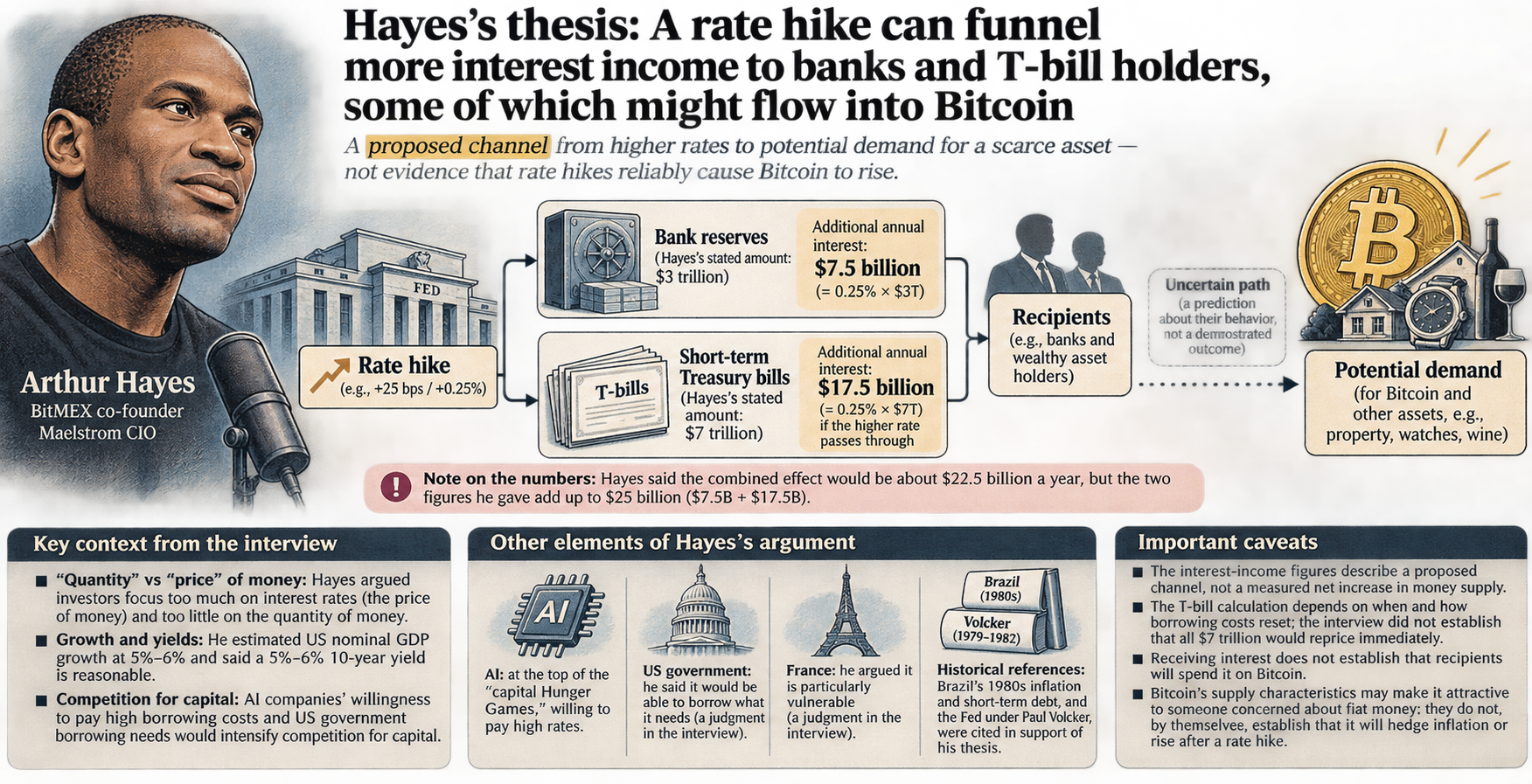
Hayes illustrated his argument with a hypothetical 25-basis-point rate increase. Applying 0.25% to his stated $3 trillion in bank reserves produces $7.5 billion in additional annual interest. Applying the same increase to his stated $7 trillion in short-term Treasury bills produces $17.5 billion annually if the higher rate passes through across that amount. He said the combined effect would be about $22.5 billion a year, but the two figures he gave add up to $25 billion, not $22.5 billion.
Those figures describe a proposed interest-income channel, not a measured net increase in money supply. The Treasury-bill calculation depends on when and how borrowing costs reset; the interview did not establish that all $7 trillion would reprice immediately. Nor does receiving interest establish that recipients will spend it on Bitcoin. Hayes predicted that banks and wealthy asset holders would direct additional income toward Bitcoin and other assets, including property, watches and wine. That remains a prediction about their behavior.
Hayes compared the mechanism with his account of Brazil’s inflation and short-term debt in the 1980s, and contrasted today’s rate-focused policy with his description of the Federal Reserve under Paul Volcker from 1979 to 1982. Those historical comparisons were presented as support for his thesis, but the interview supplied no data demonstrating that the same mechanism determines Bitcoin’s price in the US. Bitcoin’s supply characteristics may make it attractive to someone concerned about fiat money; they do not, by themselves, establish that it will hedge inflation or rise after a rate hike.