In an analysis published on November 18, 2026, Wintermute argued that Bitcoin’s rebound from its July low had failed and that the bear market was not over. Its case rested on three developments: higher interest-rate expectations, weakening sources of demand and a break below long-term price measures. The firm said Bitcoin could come under pressure toward the $50,000 range, while stressing that it was not predicting an exact bottom.
Rates, Bitcoin and gold
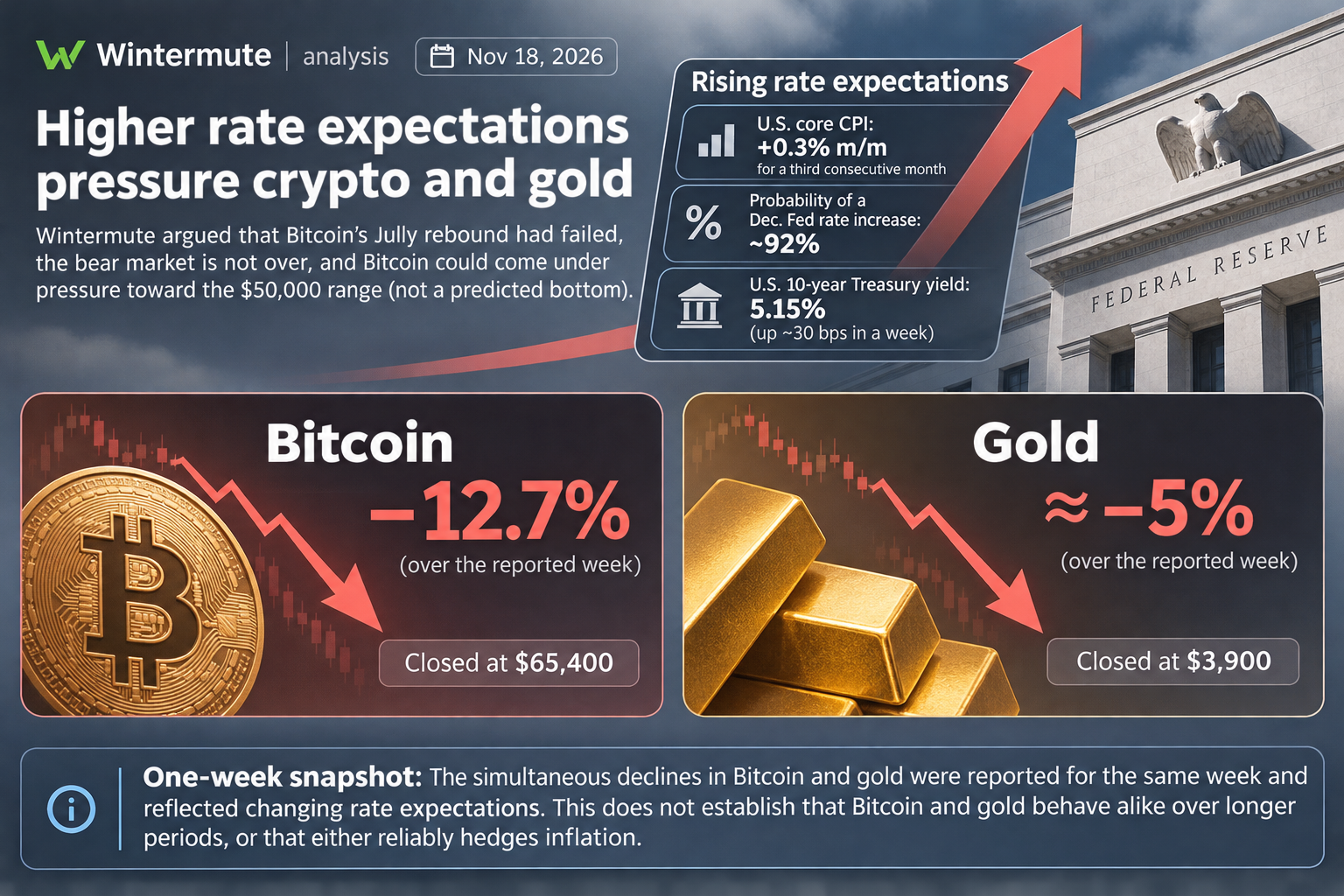
Wintermute reported that U.S. core CPI had risen 0.3% month over month for a third consecutive month, while the market-implied probability of a December Federal Reserve rate increase had reached about 92%. It said the U.S. 10-year Treasury yield closed at 5.15%, up roughly 30 basis points in a week.
Over that week, Bitcoin fell 12.7% to $65,400, while gold fell about 5% to $3,900, according to the analysis. The S&P 500 rose 2.5%. Wintermute interpreted the simultaneous selling in gold, longer-term bonds and crypto assets as a response to changing rate expectations. This one-week comparison does not establish that Bitcoin and gold behave alike over longer periods, or that either reliably hedges inflation.
The demand behind the rally
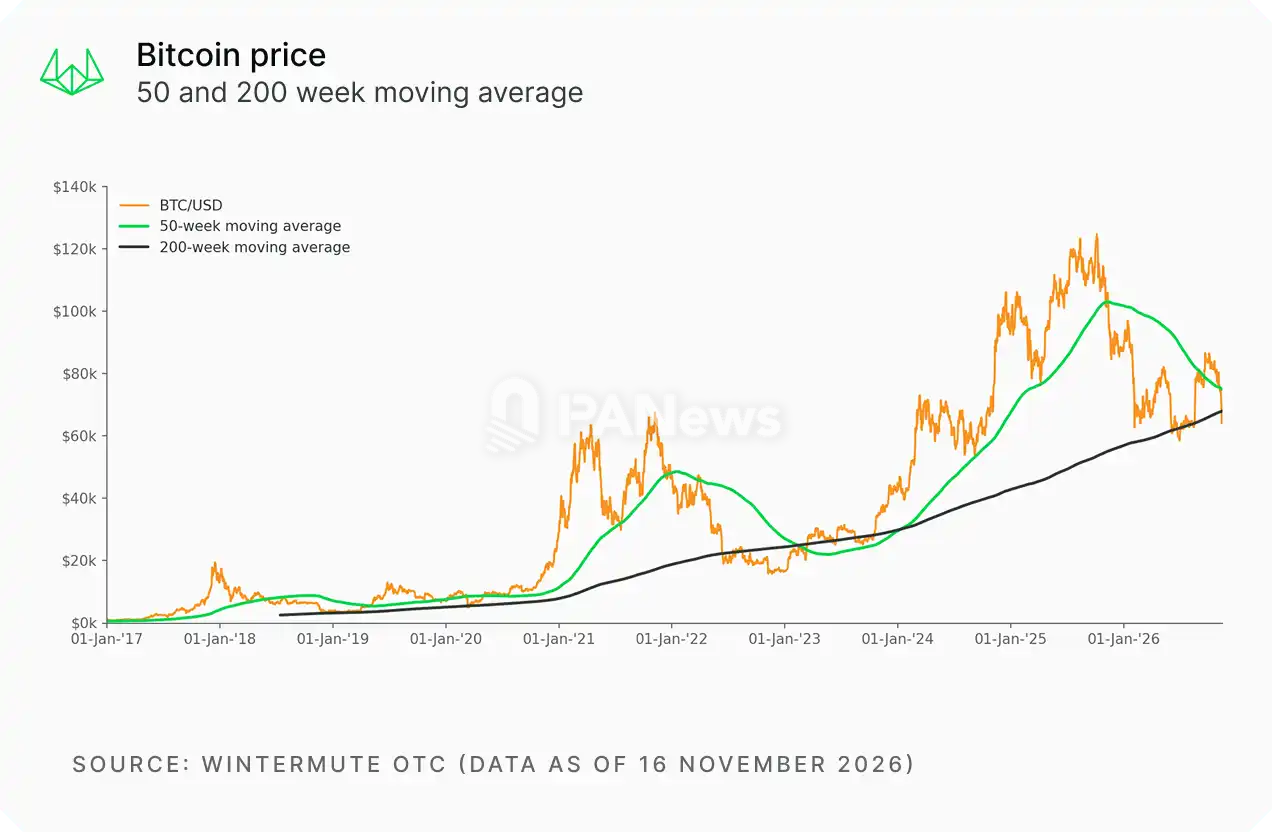
Wintermute said Bitcoin had fallen below $80,000, its 50-week moving average and then its 200-week moving average, which it placed near $68,000. It reported that Bitcoin briefly reached $62,000 the preceding Saturday, its lowest level since July.
The firm also cited approximately $1.9 billion in cumulative net outflows from U.S. spot Bitcoin ETFs so far in 2026, compared with net inflows of about $21 billion in 2025 and $35 billion in 2024. It estimated that stablecoin supply had declined by $14 billion–$16 billion over the previous 30 days and said buying by digital-asset treasury companies was weakening. These figures underpinned its view that the earlier rally lacked a sustained source of new capital.
Wintermute cautioned against treating a recent liquidation wave as proof of a market bottom. It reported roughly $1.7 billion in crypto liquidations over a 24-hour period ending Sunday, about 80% of them long positions. In its assessment, the subsequent bounce was more likely driven by short covering than by new investment.
What could change the assessment?
Wintermute identified $62,000 as an initial level to watch and $60,000 as an area with concentrated Deribit put-option positions. Its broader downside scenario reached the $50,000 range; none of those levels was presented as a certain destination.
For the firm to reconsider its short-term defensive stance, it wanted to see Bitcoin close a day back above roughly $68,000 and spot ETFs record net inflows that day. It also said easing expectations for a January rate increase could reduce pressure on risk assets. Wintermute distinguished that short-term outlook from its more favorable long-term view of Bitcoin: a potentially more attractive long-term entry price, it argued, would not by itself show that the near-term decline had ended.