Reported November 24, 2026. Grayscale said it believes Bitcoin and other leading crypto assets are oversold, while arguing that the near-term path depends more on risks tied to artificial intelligence than on blockchain fundamentals.
In the note, the asset manager wrote: “We believe Bitcoin and other leading assets are oversold, but the near-term market outlook will depend more on AI-related risks than blockchain fundamentals.”
What “oversold” means in the note
The claim is about price and positioning. It is not a statement that Bitcoin’s supply schedule changed, and it is not a finding that holding Bitcoin protects purchasing power.
Grayscale research head Zach Pandl pointed to a drop that took Bitcoin to $55,000 on Saturday, below its June low. He described that decline as the longest Bitcoin bear market on record, and also the shallowest.
Pandl cited several signals he sees as consistent with an oversold market:
- Investors pulled more than $2 billion from global crypto exchange-traded products in the week before the note.
- Holders were cashing out large amounts of stablecoins. No stablecoin total was given.
- Futures open interest had returned to summer lows.
- Options traders were paying a high premium for downside protection.
Those are flow and derivatives readings as Grayscale presented them. They do not, by themselves, determine the next price.
The outside risk placed ahead of on-chain signals
Grayscale listed a run of AI-related events since early November. Jensen Huang exited as Nvidia chief executive and then returned. The Anthropic initial public offering ranked among the largest ever. Reports also claimed that Anthropic’s Claude model had solved the Riemann Hypothesis, a mathematics problem open for nearly 170 years. That Riemann item was presented as a report, not as a confirmed proof.
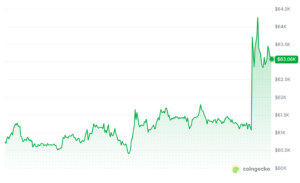
The account of the following Monday showed how those events reached crypto. Bitcoin jumped above $64,000 after Huang’s return, then quickly slid back. The Nasdaq kept its gains, and Taiwan stocks jumped the next day. The move in Bitcoin did not hold even while parts of the equity market did.

Reported price, recent buyers, and average cost
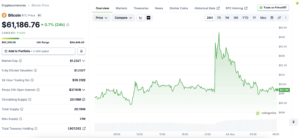
At the time of the November 24, 2026 report, Bitcoin was trading at $60,075, down about 0.7% over 24 hours, according to BeInCrypto Markets data.
Glassnode data cited in the report showed short-term holders had bought heavily between $62,000 and $65,000. Those buyers were near break-even, a point where many tend to sell. The on-chain commentary said Bitcoin was rejected after pushing into that block, and that a close above $65,000 would show demand can absorb that selling. That is a stated test of demand, not a report that such a close had occurred.
Support was described lower down. Wallets holding 10,000 to 100,000 BTC had bought near the realized price, defined as the average cost of all coins. Saturday’s low turned just above that zone. The same commentary said: “This region is strong support, and Saturday’s low turned just above it. As long as price holds over this zone, the average holder stays in profit.”
The profit point is conditional. It compares market price with the recorded average cost of coins. It does not measure inflation hedging, and it does not hold by assumption if price falls through the zone.
Grayscale still described the valuations then in place as an attractive entry for medium- and long-term holders. That is the firm’s interpretation. The same note said the near-term outlook depends more on AI-related risk than on blockchain fundamentals, including whatever on-chain floor those holder-cost figures show.
What remained unresolved
Huang faces an open Senate Banking Committee hearing on December 3. Until AI-related risk settles, the report said, Bitcoin may keep trading alongside technology stocks, whatever its on-chain floor shows.
The note therefore separates two kinds of evidence. Fund flows, the $62,000 to $65,000 short-term buying block, and the realized-price zone describe where positioning and average cost sat in this report. They do not fix the next move if the driver Grayscale emphasized remains outside crypto.