Hong Kong gazetted its Crypto-Asset Reporting Framework (CARF) legislation in November 2026, after Singapore published its implementing regulations in August. Both jurisdictions’ rules take effect on January 1, 2027, and both plan to begin exchanging crypto-asset transaction information with partner jurisdictions in 2028. The EU’s DAC8 rules, by contrast, have applied since January 1, 2026, and data collection for the first reporting year is already under way.
For a platform headquartered in Hong Kong or Singapore, having EU customers does not by itself create a DAC8 reporting obligation. Nor does filing under local CARF rules automatically discharge one. As FinTax explained in its November 26, 2026 analysis, the answer depends first on which legal entity provides the service and what connects that entity to an EU member state. The customer’s tax residence answers a different question: whose transactions must that entity report?
Which entity facilitates the exchange?
DAC8 Annex VI covers two types of reporting crypto-asset service provider: providers authorized or permitted to operate under the EU’s Markets in Crypto-Assets Regulation (MiCA), and crypto-asset operators that meet DAC8’s definition. In both cases, the relevant activity is providing a service that facilitates exchange transactions for or on behalf of reportable users.
Consider a Singapore platform offering spot trading, stablecoin conversion, custody and staking. For a spot trade or a stablecoin conversion, the starting point is to identify who contracts with the customer and who facilitates the exchange. For custody or staking, the product name alone does not settle the issue. DAC8’s service definition expressly includes staking and lending, but the actual arrangement and the transactions it facilitates still matter. An affiliate that only develops software or provides general support does not become a reporting provider simply because it belongs to the group.
MiCA authorization is also specific to the entity that holds it. If a Hong Kong group has a MiCA-authorized German subsidiary and a Singapore operating company, the German subsidiary assesses its obligations on its own services and transactions. Its authorization does not extend to the Singapore company, and a filing by either company does not automatically cover the other.
What connects an operator to an EU member state?
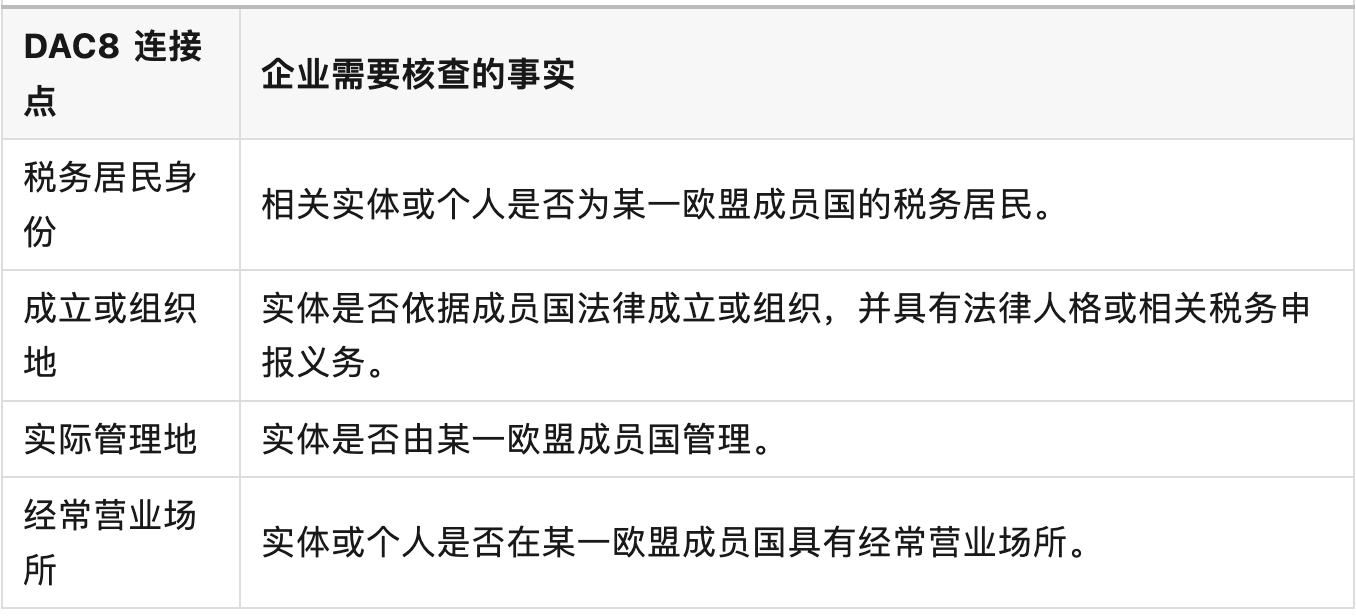
For an operator that is not authorized or permitted under MiCA, Annex VI, Section I A(2), identifies four possible connections to a member state:
- The operator is tax-resident there.
- The entity is incorporated or organized under that state’s laws and has legal personality or a relevant filing obligation there.
- The entity is managed from that state.
- The operator has a regular place of business there.
French or German customers registering on a Hong Kong exchange’s global website do not, on their own, establish any of those connections. A branch is a separate consideration: under Section I B, a reporting provider must meet local due diligence and reporting requirements for relevant transactions it facilitates through a branch in that state. A subsidiary, by contrast, is a distinct legal entity assessed on its own activities, authorization and connections. For operators that qualify, DAC8 provides for a single EU registration in a member state identified through the applicable connections.
Market access remains a separate question. MiCA’s transition period ended on July 1, 2026, and the European Securities and Markets Authority (ESMA) required unauthorized providers to wind down the relevant EU business in an orderly manner. ESMA interprets MiCA Article 61’s exception for services initiated by the customer narrowly: a contractual declaration generally cannot turn active solicitation by a firm, an affiliate or an agent into a customer-initiated request. Even where the exception applies to market access, it is not a DAC8 reporting exemption.
Which customers are reportable?
A reporting provider generally identifies reportable users by tax residence in an EU member state. Nationality, the country where an account was opened and the IP address used to access it are clues, not proof. A Singapore resident, for example, might access an account through a French network.
The provider must obtain a self-certification and check whether it is reasonable against existing customer records. For an individual, the declaration includes name, address, tax-residence jurisdiction or jurisdictions, corresponding tax identification numbers and date of birth. For an entity, the provider checks whether it is an excluded person or an active entity. For other entities, it must identify controlling persons and determine whether they are reportable.
New customers must provide the declaration when the relationship begins. For existing individual and entity customers, providers must obtain it before January 1, 2027, and check it against information they already hold. If changed circumstances make a declaration incorrect or unreliable, the provider needs a valid replacement or a reasonable explanation, with appropriate evidence, for continuing to rely on the original.
When can a local CARF filing prevent duplicate reporting?
Domestic legislation, signature of a multilateral competent authority agreement (MCAA) and eligibility for DAC8 relief are distinct legal steps. DAC8 sets separate conditions for relief from duplicate provider-level due diligence and reporting, and for avoiding duplicate reporting of a particular user’s information. A platform must check the jurisdiction’s qualifying status, the agreement in force with the relevant member state for the reporting year, whether the information corresponds to what DAC8 requires and whether the platform has actually reported it locally.
Under Annex VI, a qualifying non-EU jurisdiction must have an effective qualifying competent authority agreement with each member state on its published list of reportable jurisdictions. Article 8ad allows information under the OECD framework to count as corresponding information if CARF is determined to be a minimum or equivalent standard. It still requires an agreement between the jurisdictions concerned.
Ireland’s Revenue lists Hong Kong and Singapore as jurisdictions with which it expects first exchanges in 2028 under the MCAA. That is evidence of Ireland’s planned arrangements, not proof that every member state has an effective agreement with either jurisdiction. Nor does a planned 2028 exchange establish relief for the 2026 reporting year.
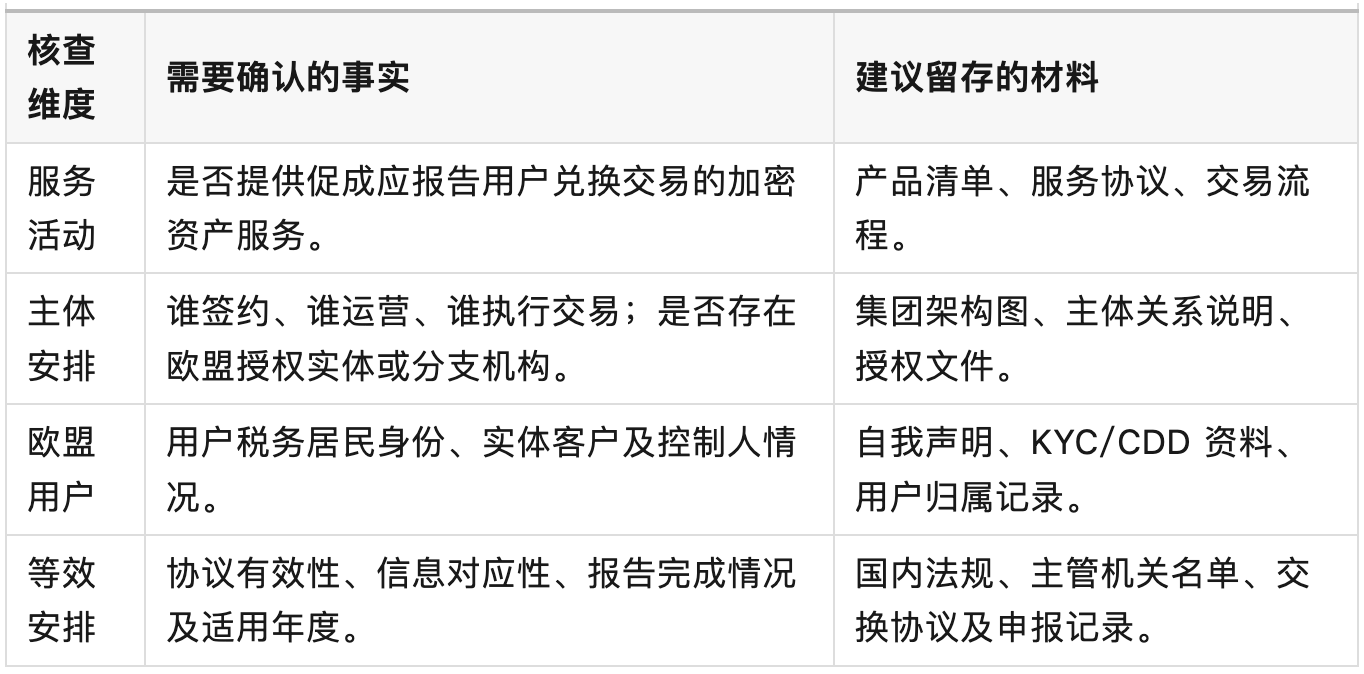
For a cross-border group, the useful record is therefore more than an organization chart. It connects each customer agreement and transaction to the entity that performs the service, documents that entity’s EU connections, and identifies the customer’s tax residence and the exchange agreement applicable for the year. A change in who signs the customer contract or executes the trade can require a fresh assessment even when the group’s headquarters stays put.