In its November 20, 2026 report on third-quarter 13F filings, ChainCatcher described a record snapshot of U.S. spot Bitcoin exchange-traded product (ETP) holdings. The filings show where reportable positions stood on September 30—not what those institutions held when the filings became public, or whether every position was an unhedged bet on Bitcoin.
Galaxy Research’s November 19 compilation put the holdings of 2,166 reporting institutions at 356,491 BTC equivalent, worth $29.78 billion at quarter-end. That was a record in BTC terms, following a quarterly net increase of 49,229 BTC equivalent, or about $4.11 billion—the largest single-quarter increase since Q2 2025.
The snapshot had already aged by publication. Galaxy reported that, by November 16, total BTC held by the relevant funds had fallen by 38,531 BTC from quarter-end to 1,252,139 BTC. Over the same interval, Bitcoin’s price fell from about $83,580 to $64,943. Those later figures do not identify which 13F filers, if any, sold.
Wealth-management accounts drove much of the increase
Investment advisers and wealth-management platforms held 144,307 BTC equivalent, or 40.5% of reported 13F holdings, according to Galaxy. They supplied roughly half the quarter’s net increase and had been net buyers for nine consecutive quarters. Their holdings were about 3.3 times their March 2024 level.
Hedge funds’ share of reported holdings, meanwhile, fell from 50.6% at the end of 2024 to 19.0%. That does not mean trading-oriented funds uniformly withdrew: the report recorded quarterly net increases of 10,492 BTC equivalent for macro funds and 9,184 for basis and relative-value funds.
Growth was concentrated. The 50 largest holders added a combined 59,578 BTC equivalent, while all other reporting institutions together reduced holdings by 10,349. BlackRock’s IBIT accounted for 65.2% of reported institutional holdings and 34,744 BTC equivalent of the quarter’s net increase.
A large filing is not necessarily a bank’s own investment
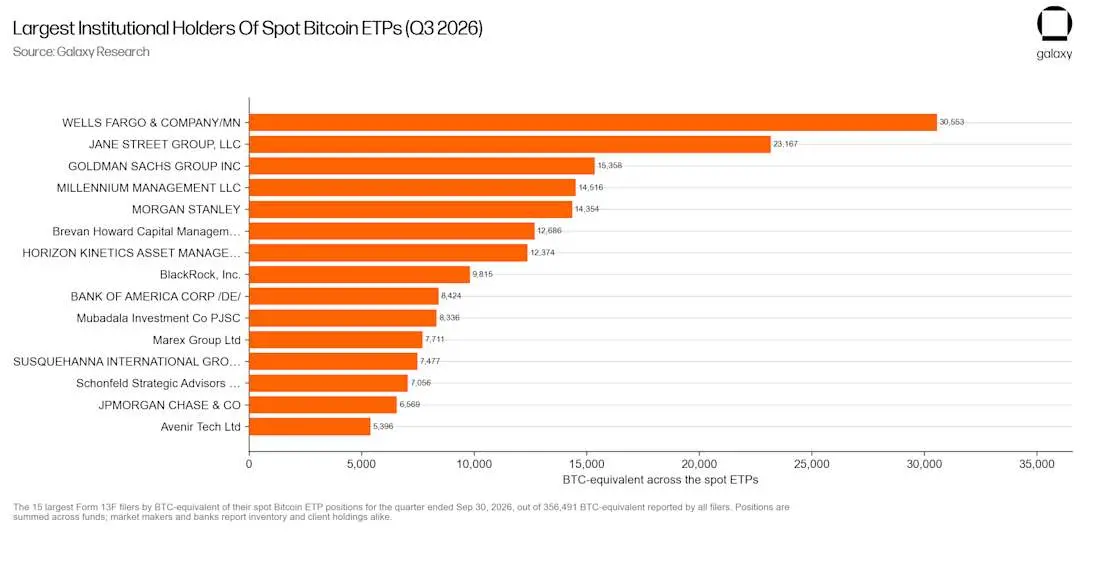
Wells Fargo became the largest reported 13F holder of spot Bitcoin ETPs, overtaking Jane Street. Its position rose from about 15,900 BTC equivalent at the end of Q2 to 30,553, worth roughly $2.55 billion; its IBIT shares approximately doubled from 24.4 million to 49.58 million. Millennium had held the top spot from Q1 2024 through Q1 2026.
Galaxy Research head Alex Thorn cautioned that about 85% of Wells Fargo’s reported IBIT holdings came through two brokerage divisions. He characterized those as client holdings, rather than positions held for the bank’s own account or trading business. The 13F ranking therefore cannot, by itself, establish a $2.55 billion balance-sheet allocation by Wells Fargo.
Other banks reported larger IBIT share counts: Bank of America rose from about 1.72 million to 14.48 million shares, Morgan Stanley increased roughly 18% to 19.52 million, and JPMorgan Chase increased about 9.6% to 11.41 million. The filings do not identify the ultimate beneficial owners of all those positions.
Goldman Sachs reported spot Bitcoin ETF holdings worth $1.283 billion, up 121% from about $580 million. Share counts tell a more qualified story. Its largest individual holding, IBIT, fell about 5% to 16.44 million shares even as its value rose to $778.3 million, largely because IBIT’s quarter-end price increased from $33.29 to $47.34. Its FBTC shares, by contrast, rose from about 106,000 to 5.48 million, worth approximately $397.9 million. Goldman also established an MSBT position worth about $47.9 million.
Beyond Bitcoin funds, Goldman’s reported Ether ETP holdings rose from roughly $210 million to $1.22 billion, while its XRP and Solana fund holdings reached about $144 million and $180 million, respectively. It cut its long position in Strategy by nearly 52% to about $422.6 million. The four fund categories together represented about $2.8 billion—roughly 0.25% of Goldman’s total reported 13F portfolio. Rising dollar values should not be mistaken for an equivalent amount of net buying.
Hedge-fund positions need a different reading
Millennium’s spot Bitcoin ETF long positions rose in reported value from about $434.9 million at the end of Q2 to $1.21 billion. Its IBIT shares increased 115% to 20.82 million, worth about $985.5 million, after it had reduced that position over two quarters from 34.33 million shares at the end of 2025 to 9.69 million.
Jane Street’s mix changed across products: its IBIT shares fell 18.7% to 20.22 million, while FBTC rose about 691% to 7.01 million shares and ARKB rose from roughly 2.7 million to 11.69 million. Looking at IBIT alone would miss those increases elsewhere.
Options make the direction of some exposures still harder to infer. Millennium reported IBIT calls covering about 6.11 million shares and puts covering 2.75 million. Jane Street reported calls covering about 34.97 million shares and puts covering 45.32 million—both greater than its IBIT shareholding. Goldman reported IBIT puts covering about 7.51 million shares. A 13F shows quarter-end long positions and certain listed options, but not short positions, futures or swaps; it also does not explain an option’s strike, expiry or purpose. An ETF long position may be one leg of a hedged strategy.
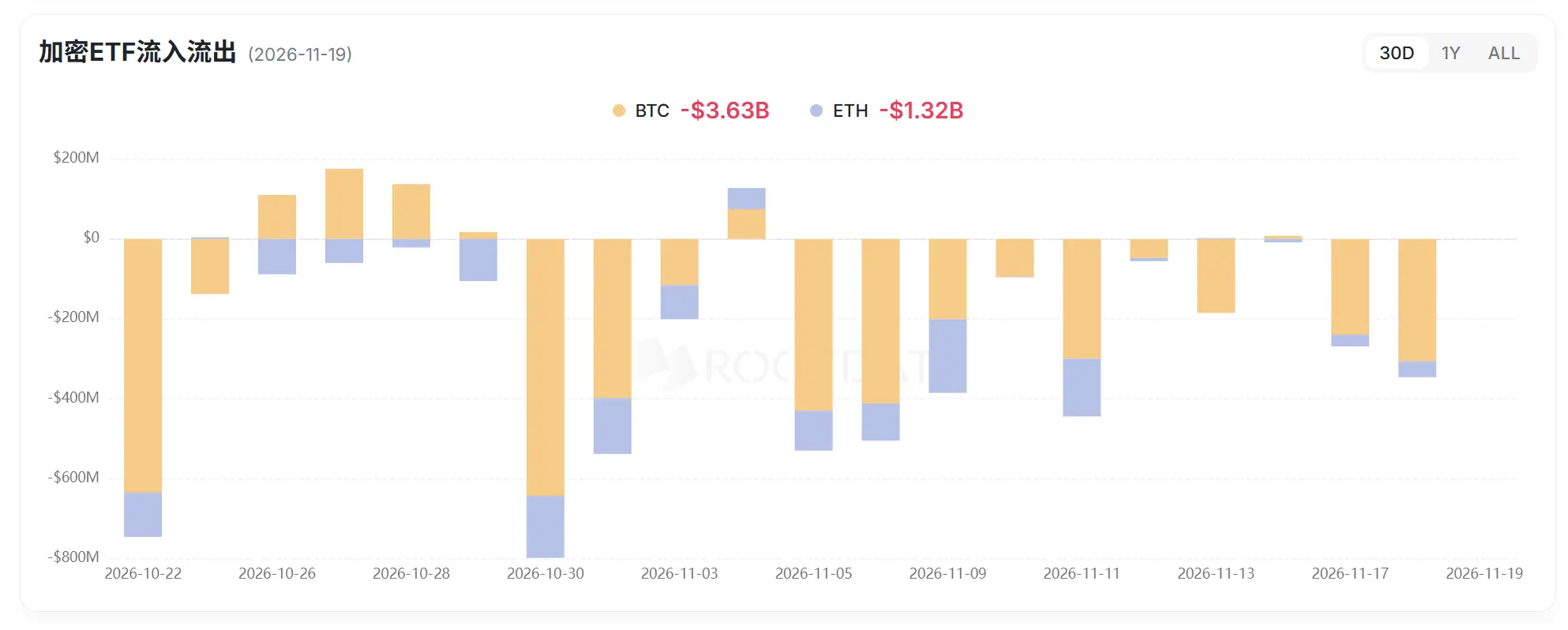
RootData reported approximately $3.63 billion of net outflows from spot Bitcoin ETFs over the month preceding the November report. That flow measure and Galaxy’s change in fund BTC holdings point in the same direction, but use different measures and cannot be subtracted from one another or assigned to specific 13F filers.
The defensible longer-term observation is about distribution: reporting institutions held 27.6% of the BTC in the funds at quarter-end, up from 24.8% at the end of Q2. Whether wealth-management demand proves steadier than trading-fund demand remained untested by the full Q4 redemption period. As ChainCatcher noted at the time, the next filing round, expected in mid-February 2027, would provide a later snapshot—not a real-time account of those investors’ decisions.