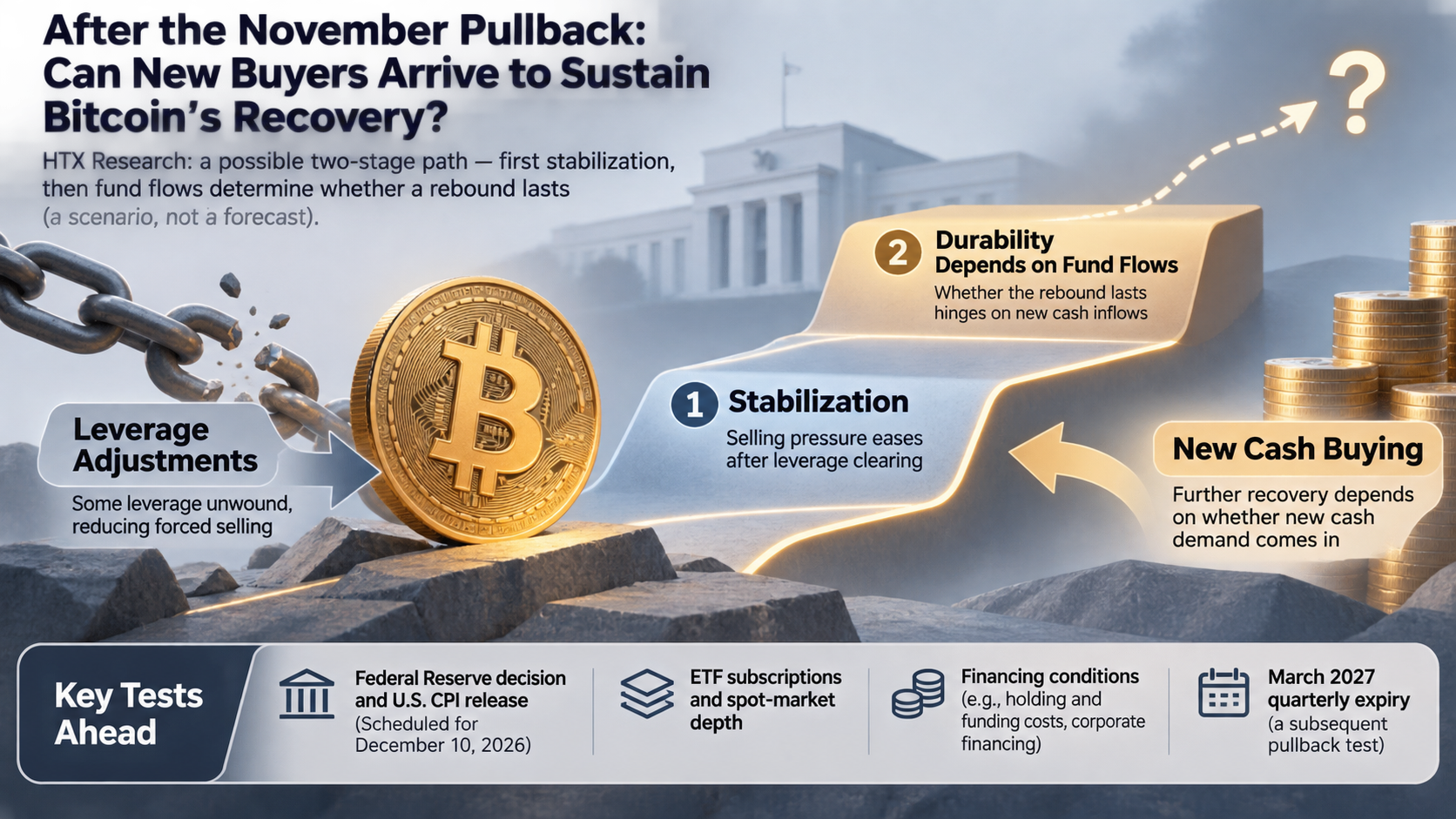
In reporting published on November 20, 2026, HTX Research assessed Bitcoin’s prospects after a sharp November decline cleared some leveraged positions. Its central question was whether new cash buyers would arrive as forced selling eased. The firm envisaged a possible two-stage recovery: Bitcoin first stabilizes, then fund flows determine whether a rebound lasts. That is a scenario, not a forecast of guaranteed gains.
Prices recovered faster than participation
HTX Research said total crypto market capitalization rose 39.6% quarter on quarter in the third quarter, without a comparable increase in spot trading. Citing Farside data, it reported $2.579 billion in net outflows from U.S. spot Bitcoin ETFs between November 2 and 17. It also cited DeFiLlama data showing that stablecoin market capitalization had fallen 5.33% over the 30 days through November 18.
The report placed Bitcoin in a $62,000–$66,000 range that it described as a recent buyer cost zone. In its view, the clearing of some leverage did not establish that fresh cash demand was ready to absorb further selling.
What could sustain a recovery?
HTX Research argued that financing conditions over the following six months mattered more than any single interest-rate decision. Even unchanged rates could raise investors’ expected holding costs if anticipated easing were delayed. It also distinguished easing alongside cooling inflation and stable income from rate cuts prompted by a sharp deterioration in demand; the two paths need not affect Bitcoin in the same way.
The report identified several tests ahead, including the Federal Reserve decision and November U.S. CPI release scheduled for December 10, 2026. It cautioned that a rebound after those events might reflect changes to existing positions rather than new allocations. For listed Bitcoin treasury companies, it argued that a narrower share-price premium or more expensive financing could reduce expected future purchases even without Bitcoin sales.
The stronger test, according to HTX Research, would come during subsequent pullbacks: whether each decline produced fewer forced sellers, and whether ETF subscriptions, spot-market depth and financing conditions held up. It pointed to the March 2027 quarterly expiry as one such test. A quick price rebound alone, the report argued, would not demonstrate that the market’s balance sheet had repaired.