Bitcoin traded around $60,000 on November 25, while gold fell below $3,500 intraday to its lowest level since September 2025. U.S. stocks recovered most of a sharp sell-off: the S&P 500 fell as much as 3.2% before closing down 0.25%, while the Nasdaq fell more than 4% before finishing 0.62% lower.
The market review published on November 27, 2026, at 16:45 UTC+8 put those moves in historical context. For Bitcoin, the clearest change around Thanksgiving was not the direction of prices but how much trading took place. For gold, the holiday record showed little directional bias to begin with.
Bitcoin trades around the clock, but holiday volume has fallen
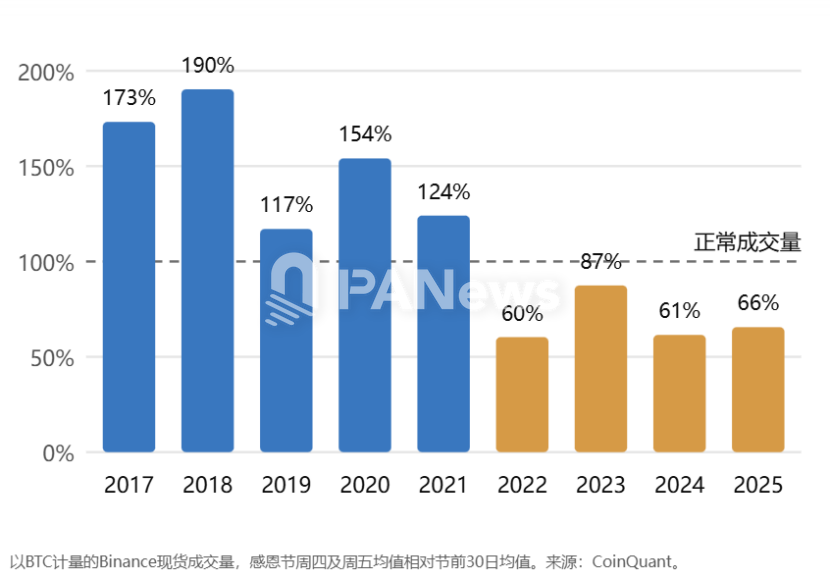
CoinQuant found that Bitcoin trading volume during Thanksgiving was generally above ordinary levels from 2017 through 2021. From 2022 through 2025, it was below normal in all four holiday periods, by an average of 31.3%. Kaiko documented a similar shift on weekends: their share of Bitcoin volume fell from 28% in 2019 to 16% in 2024. The exchange calendar had not changed, but as institutions, spot ETFs and professional market makers took a larger role, more trading followed Wall Street’s working week.
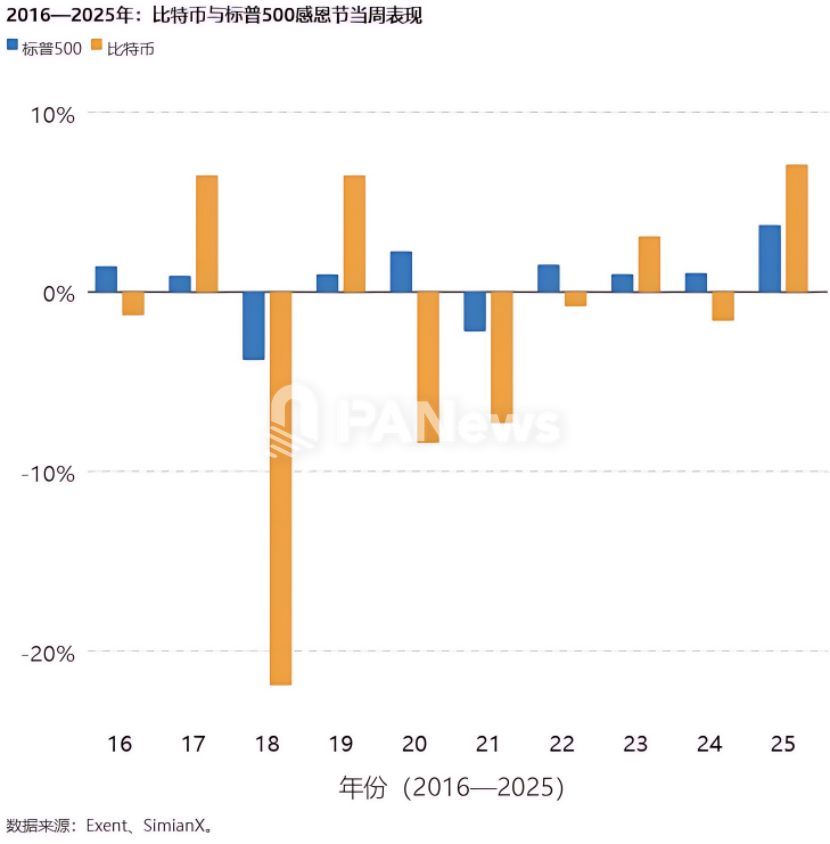
The price record depends on the period chosen. According to SimianX, Bitcoin rose in nine of the 15 Thanksgiving weeks from 2011 through 2025, with a mean return of 4.4% and a median of 4.9%. The 40.6% gain in 2013 lifted the long-run average. Over the most recent ten years in that sample, Bitcoin rose in only 40% of Thanksgiving weeks and averaged a loss of 0.73%. It gained in the week after Thanksgiving in each of the past five years, but that is a separate, shorter record.
One immediate uncertainty was the Black Friday expiry of monthly options on Deribit covering roughly 111,800 BTC. Nearly half of the negative gamma exposure was due to roll off. Glassnode warned that, while that exposure remained, market makers seeking to keep their positions neutral to Bitcoin’s price might have to buy as it rose and sell as it fell, amplifying moves in either direction. Buying by digital asset treasury companies had also stalled, institutional money continued to leave ETFs and short-term holders’ losses were widening. Those pressures did not require a wave of forced liquidations to weigh on the spot market.
Gold’s mixed record puts the focus on real yields
COMEX gold futures rose in 11 of the past 20 Thanksgiving weeks and fell in nine, according to GoldInvestor. The average price swing was about 2%, not an average gain of 2%. FOREX.com analyst Matt Simpson found that the Tuesday before Thanksgiving and the Friday after it had somewhat stronger records, with gains 58.9% and 61.5% of the time, respectively.
In November 2026, investors faced a more immediate trade-off. Trade friction, geopolitical conflict and a sell-off in technology shares could support demand for gold as a refuge. But gold pays no interest, and high inflation-adjusted yields increased what investors gave up by holding it rather than interest-bearing assets.
On November 24, BCA Research chief commodity strategist Roukaya Ibrahim ended a four-year long gold trade. She cited elevated real yields, the possibility that the dollar index could reach 105 in the near term and the risk that gold ETF holdings had further to fall. Bridgewater founder Ray Dalio took a longer view, arguing that gold still warranted a 10%–15% portfolio allocation amid high debt and escalating trade conflict. He said central banks were pushing gold toward the position of the world’s second-largest currency. That was an argument about gold’s monetary role, not a claim that it would rise during the holiday.
Bank forecasts also differed. Goldman Sachs cut its end-2026 gold target to $4,150, while UBS retained its $4,500 target. Morgan Stanley named gold its preferred commodity for 2027 in its November outlook.
U.S. stocks had already rebounded before the holiday
The S&P 500 entered Thanksgiving week down 8.83% for the month and 11.62% below its October 6 record. Its 4.73% rebound on Monday, November 23, left the index up about 3.94% for the week through Wednesday’s close despite two consecutive daily declines. By comparison, Exent counted gains in 53 of the 76 Thanksgiving weeks from 1950 through 2025, with an average return of about 0.7% and a median of 0.87%. Black Friday itself had a historical gain rate of 71.1%, but from 2006 through 2025 it rose only half the time, with a median return of −0.04%.
The rebound also concealed differences in positioning. Vincent Lin, co-head of Goldman Sachs Prime Insights and Analytics, said hedge fund clients had reduced overall risk exposure for five consecutive weeks while adding to short positions in individual stocks, index futures and ETFs. Goldman estimated that trend-following funds would sell $28.6 billion to $80.6 billion the following week under its market scenarios. That was projected selling, not a recorded outflow. U.S. equity ETFs and mutual funds, by contrast, had attracted about $150 billion over the preceding month.
The VIX hovered near 27, above its long-run median of 17.6, even as banks projected higher stock prices over a longer horizon. Deutsche Bank set an end-2027 S&P 500 target of 9,000 on November 25; Goldman Sachs and Morgan Stanley projected 8,700, and JPMorgan projected 8,200.
The dollar remained near its high for the year, though on November 25 the dollar index slipped 0.14% as the U.S. 10-year Treasury yield fell 6.2 basis points to 4.84%. StoneX counted 20 declines in the dollar index between Thanksgiving and year-end since 2000, with an average decline of 1.08%. Rate-increase expectations still supported the dollar, while growth concerns and demand for longer-dated Treasuries worked against its yield advantage. OCBC currency strategist Sim Moh Siong judged the balance of risk and reward from pursuing further dollar gains less attractive.
The holiday figures describe different things: how often prices rose, by how much and how actively an asset traded. Lower Bitcoin volume does not predict a loss, just as gold’s narrow majority of positive Thanksgiving weeks does not establish that it provided a hedge. Those distinctions mattered more than the calendar amid shifting yields and reduced institutional risk exposure.