Bitcoin addresses holding between 1,000 and 10,000 BTC increased their combined balance by 121,117 BTC from September 30 to November 21, 2026, even as Bitcoin’s price fell 29.5%. The 4.29% increase brought the group’s holdings to approximately 2.95 million BTC, according to a November 27 report from CryptoQuant supported by crypto lender CoinRabbit.
The increase ran counter to a pattern seen in seven of the previous nine fourth quarters, when balances in that group declined. In the fourth quarter of 2025, the decline was nearly 203,000 BTC. The 2026 figures show where more bitcoin was held, but not necessarily who bought it: transfers between addresses and changes in custody can alter the group’s balance without a market purchase.
Larger balances, smaller profits
CryptoQuant found that the group’s unrealized profit fell from $124.7 billion at the end of September to $23.8 billion on November 21. Its unrealized profit margin narrowed from 33.9% to 5.7%. Separately, the group recorded an average daily realized loss of $41 million during the quarter to date.
Large traders placed $366 million in derivatives buy orders earlier in the week of November 27. Meanwhile, whale-sized deposits to exchanges rose to an average of 5,012 BTC per day in November. Neither measure establishes that a trade took place: a buy order is not a completed purchase, and bitcoin deposited on an exchange need not be sold.
Losses extended beyond large addresses. Glassnode data showed that realized losses relative to capital inflows over the preceding year were the heaviest since the FTX collapse in 2022. Similar readings have occurred near earlier market lows, but they do not establish that the price has bottomed.
ETF flows and US demand
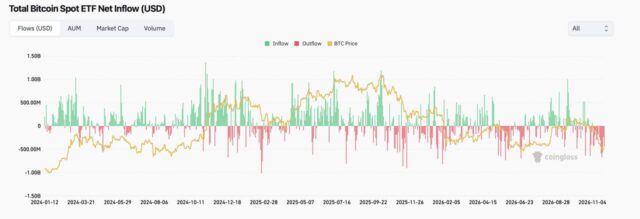
US spot Bitcoin ETFs recorded $453 million in net outflows on November 25, including $329.7 million from BlackRock’s IBIT, according to Farside Investors. Figures for November 27 had not yet been confirmed at the time of reporting. CoinGlass data showed that withdrawals had predominated in recent sessions, in contrast to the substantial inflows earlier in the rally.
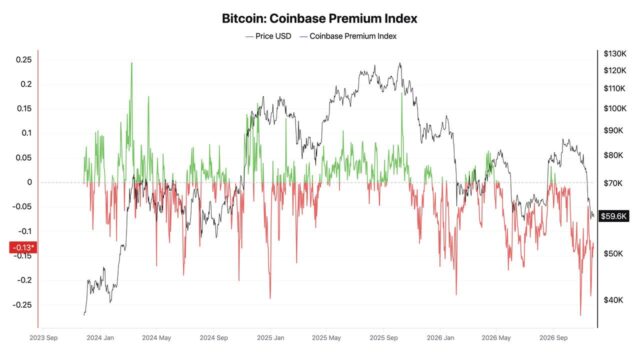
The Coinbase Premium Index, which compares Bitcoin’s price on Coinbase with its price on Binance, stood at approximately −0.13%. That discount suggested weaker buying pressure on Coinbase. A sustained premium alongside consistent ETF inflows would offer stronger evidence of improving US demand than the change in large-address balances alone.
Bitcoin’s daily chart still showed lower highs and lower lows after the price slipped below $60,000. The first resistance region was $63,000–$64,000, followed by $68,000–$71,000. A fall below the recent low near $55,000 would weaken the case for a year-end rebound. A recovery from that low remained possible, but it was a different prospect from a return to the previous all-time high. The address data did not confirm either outcome.