US spot Bitcoin ETFs recorded a total net outflow of $570 million on 23 November 2026, US Eastern time, a fifth consecutive day of net outflows, according to SoSoValue. Fidelity’s FBTC had the largest single-day net inflow, $13.2877 million, and its cumulative historical net inflow stood at $9.969 billion. BlackRock’s IBIT had the largest net outflow, $509 million, against a cumulative historical net inflow of $62.316 billion. At the time of those figures, spot Bitcoin ETF assets were $74.125 billion, equal to 6.02% of Bitcoin’s total market value, and cumulative historical net inflows were $52.274 billion.
The figures are observed flows and a reported share of market value. They do not by themselves show why shares were redeemed or whether the outflow streak continues.
A research note on a long, relatively shallow drawdown
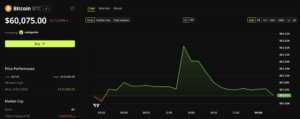
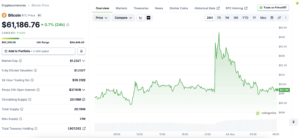
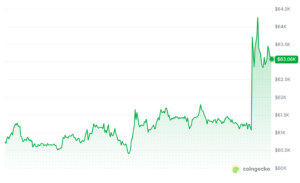
Zach Pandl, Grayscale’s head of research, said the crypto market had been sharply volatile over the prior week and that Bitcoin and other major assets were oversold. In his view, the near-term outlook depends more on AI-related risks than on blockchain fundamentals. He said Bitcoin fell as low as $55,000 on 21 November, below the prior low of $58,000 on 30 June. On that reading, the current bear market is the longest on record, at least 411 days, and also the shallowest, with a drawdown of 56%. Price had partly recovered to about $62,000 when he wrote.
He tied that description to other measures from the same window: global crypto exchange-traded products saw more than $2 billion of outflows over the prior week; stablecoins saw notable redemptions; Bitcoin and ether futures open interest had fallen back to summer lows; and the options market’s implied-volatility curve was deeply inverted. Pandl said public-blockchain fundamentals were sound and that current valuations were an attractive entry for medium- and long-term holders, while risk in AI-related assets remained high. The entry-point claim is his judgment. It is not a completed measurement of hedging performance, and it does not establish that the drawdown has ended.
Direct coins, metal, and an ETF share
On 23 November, Robert Kiyosaki, author of Rich Dad Poor Dad, again said he would rather buy Bitcoin, ether, gold and silver directly than through ETFs, Bitcoin.com reported. He gave as reasons his concerns about Federal Reserve policy, US debt and financial crisis, and he wrote: “The crash we are sliding into is much bigger than 2008 and could be a global depression.” He pointed to 2008 subprime-related derivatives and the failure of Lehman Brothers, described the derivatives market as running to tens of trillions of dollars, and said more money would be created. He put US debt at $49 trillion. US Treasury figures cited alongside that claim showed total outstanding public debt of $40.71 trillion as of 19 November.
What he is comparing is the form of the claim, not a shared supply schedule. A spot ETF share is a fund interest. The coins or metal he says he wants to hold sit outside that fund. The report does not show that holding any of them directly preserved purchasing power, that they moved together over a stated period, or that they worked as a hedge. His debt figure and the Treasury figure are different numbers, and the depression warning is his forecast.
Reported shifts in coin holdings
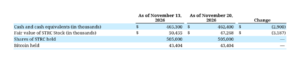
Strategy bought 457 bitcoin over the past week, raising its holdings to 851,305 bitcoin, and repurchased $212 million of STRC stock.
On-chain analyst Yu Jin said Abraxas Capital, which he described as an asset manager and hedge fund, withdrew a further 2,223 bitcoin, about $141 million, from Kraken during the prior night’s rebound. Over the latest three days it had moved 19,820 bitcoin, about $1.182 billion, off centralized exchanges and onto the chain, at an average price of $59,665.
Lookonchain reported that MARA transferred 276.7 bitcoin, about $16.97 million, to Galaxy Digital, which the monitor characterized as selling, while Twenty One Capital received 172.25 bitcoin, about $10.50 million, from Anchorage Digital, which the monitor characterized as buying. Another trader was reported to have bought 726 bitcoin over nine days, about $45.83 million. These are reported transfers and a monitor’s reading of them. A transfer is not itself a published sale price, and none of the reports describes a change in Bitcoin’s issued supply.
An address that spent $29.18 million on TRUMP a year earlier was reported to be showing an unrealized loss of $25.96 million, a decline of 89%. Separately, a whale or institution was reported to have withdrawn $12.20 million of PEPE from Binance over six days.
A draft law, a future UK limit, and staff guidance
South Korea’s government published a Digital Asset Basic Act as a comprehensive legal framework for the crypto industry. The bill would allow initial coin offerings and market making by crypto exchanges, create a bank-centered consortium to issue a domestic-currency stablecoin, and cap a major shareholder’s stake in an exchange at 20%. The draft is to be sent to the legislature for further discussion. Those permissions are not described as rules already in force.
In the United Kingdom, Bitcoin Magazine reported, operators of crypto exchanges are to be prohibited from trading with their own funds on platforms they run, while a new Treasury order allows independent market makers to trade on those platforms without a separate trading permission. Final rules from the Financial Conduct Authority say a firm may not execute orders with its own funds on a qualifying trading platform it operates, meaning it cannot act as market maker on its own platform. That restriction takes effect on 25 October 2027. The FCA rules were published on 30 June in policy statement PS26/11. What changed over the past week was the Treasury framework: on 18 November 2026 the Treasury made amending regulations adding Article 9UA, which carves activity such as market making on a qualifying cryptoasset trading platform out of the regulated activity of dealing as principal.
Staff of the US Commodity Futures Trading Commission issued guidance that lets regulated derivatives platforms, if specified valuation haircuts are applied, count bitcoin, ether and eligible payment stablecoins toward the financial resources required to cover at least 12 months of operating costs. The same guidance says crypto assets are not “cash” or “highly liquid securities” under generally accepted accounting principles, so they do not satisfy a separate liquidity requirement. Crypto journalist Eleanor Terrett said the rules had not previously stated clearly whether crypto could count toward the operating-cost test. The guidance does not treat those assets as cash.
The Block reported that a CFTC proposal on prediction markets had been sent to the White House Office of Information and Regulatory Affairs. The file is titled “Prediction Markets; Public Interest Determination” and indicates that staff are considering a recommendation that the commission propose rules clarifying the framework for event contracts. The proposal would limit contracts linked to gaming, war, terrorism and assassination, and more than 1,300 comments had been received. Chairman Michael Selig has maintained that the agency has “exclusive jurisdiction” over event contracts as federally regulated swaps. Several states say prediction markets are in substance illegal gambling, and the dispute has become litigation. Forty-four state attorneys general jointly opposed the rulemaking, and New Jersey has asked the Supreme Court to decide which authority has jurisdiction. The item is a proposal under review, not an adopted prohibition.
The US Justice Department filed a lawsuit seeking forfeiture of more than $1 billion in crypto assets stolen from Binance by North Korean hackers.
A larger Ethereum security team, and a transition that is not yet in force
The Ethereum Foundation said it had doubled its protocol security team in order to speed work against quantum-computing and AI threats, Cointelegraph reported. Researcher Kev Wedderburn wrote that AI is now a more urgent risk than quantum computing. Changes that are planned would alter how validators sign messages, how users authorize transactions, and how Ethereum checks rollup data. He said this upgrade is harder than the 2022 Merge and allows less time, and that a faster development pace also makes it easier to introduce bugs. That is the reason he gave for enlarging the security team, so formal verification and security work can keep pace. Earlier this month, researcher Justin Drake proposed finishing a quantum- and AI-resistant transition by December 2028, a year sooner than the timeline previously announced. The staffing increase is what the foundation says has already happened. The cryptographic change is not described as activated.
Altcoin losses, and an unresolved wash-trading claim
CryptoQuant analyst Darkfost said altcoins had been hit hardest in the present drawdown. From the previous market peak in September, total altcoin market value — TOTAL2, crypto excluding bitcoin — had fallen 34%, a $408 billion loss of sector value. On Binance, the share of altcoins trading above their 200-day moving average had fallen from 90% to 19%. Meme coins had not recovered investor interest: cumulative buy-versus-sell volume on Binance showed a net imbalance of $1.5 billion on the sell side, and memes’ share of altcoin market value had dropped from 11% in the November 2024 meme boom to 2%. The same account said the industry recorded more than 207 exploits in the first half of 2026. Those are reported measures for the windows given, not a projection.
Competition over tokenized Anthropic stock in the Solana ecosystem had turned into a dispute, and the manipulation claim remains unproven. Ondo Finance’s head of DeFi accused Backpack Securities of wash trading its tokenized Anthropic stock, $ANT. Backpack launched $ANT on 19 November, nine minutes after the Anthropic IPO. Volume over the first two days exceeded $140 million in total, peaked near $58.2 million on 20 November, and had fallen to $6.3 million by 22 November. Analysis from Ondo and Securitize pointed to the same wallet repeatedly buying and selling, and said 52% to 64% of sampled volume may have been wash trading or bot loops. Backpack and Sunrise both denied the accusation. The report says there is still no definitive evidence of intentional manipulation.
Exchange notices
Binance said it would run wallet maintenance at 14:00 on 25 November 2026, China Standard Time (UTC+8). Withdrawals on every network would be paused from that time. The work was expected to take 60 minutes, after which withdrawals would resume automatically.
Binance also said claims and trading for a Binance Alpha airdrop would open at 18:00 on 24 November 2026, UTC+8. Users holding at least 253 Binance Alpha points could claim first come, first served, until the pool was used up or the event ended. The token itself had not yet been named on official channels.
Bithumb said it would list ON, SANC and SQD on its won market, with the opening time left to a further official notice. Upbit said it would list RPL, ACU, DBR and ON on its BTC, USDT and won markets, with trading set to begin at 12:30 local time on 24 November.
Nvidia’s reinstatement, as commentators used it
Nvidia said that, effective immediately, Jensen Huang was restored as president, chief executive and a member of the board. The board said that after several rounds of discussion with him it had voted unanimously to restore him, and that it found him candid and able to lead the company. It said it had heard senior US government officials and, on that basis, was satisfied that his return would not create a national security risk. Chair Harvey C. Jones said Huang was the right person to lead Nvidia and that the reinstatement served shareholders, employees, partners and customers. The company thanked Colette Kress for her work as interim chief executive; she remains chief financial officer.
Market commentary did not treat that decision as a settled fact about Bitcoin. Liquid Capital founder Jack Yi wrote that the market had rebounded quickly in the short run after Huang’s return, but that he still did not believe the medium-term trend had turned. He said the wider setting was a rate-hiking cycle, that financial risks had not been removed, and that deleveraging and a squeeze on froth would not finish soon — and that, in particular, the fight would only be starting once Democrats formally take office in January. He called this year brutal, said next year could be more dangerous, and again urged people not to use leverage, to hold ample cash and to treat a crisis with respect. That is his view, including the political date he gave. It is not a policy announcement.
Arthur Hayes wrote that a rising Nvidia share price was the worst case for the crypto market, and that US equities would have to fall hard before the Federal Reserve would print money. That is an argument about what he thinks would force policy. It is not a decision the Fed is reported to have taken.
Yu Jin also described a position on Hyperliquid. An address he labeled a smart-money whale, showing an unrealized profit of $17.86 million on a short of 30,000 ETH, shorted 200,000 Nvidia shares at $167, about $33.39 million, after Nvidia had rebounded 30%, and was the largest Nvidia short on that platform. The address had made $17.78 million on a long ETH position, then reversed into an ETH short that was showing a further unrealized profit of $17.86 million. A reported position is not evidence that the equity rebound must reverse.